

Print with Principles – Why Print Products (still) Play a Role in Green Hotels
Hotels are increasingly turning to digital communication solutions, which is also evident in the Green Pearls® network. At the same time, there are good reasons not to completely abandon print formats, but to use them in a targeted manner for branding and customer loyalty. This is as much about content as it is about implementation.
When the Print Itself Becomes the Message

The fourth (printed) edition of the guest magazine BergGeist of the Hotel Das Rübezahl in Schwangau was published in early April. This begs the question: Why do they still rely on a printed product in times of energy efficiency and digital change? "We want our guests to take the time to sit down, flip through the pages, and feel the stories. This is more likely to happen with a print magazine than with a quick scan of an online text," explains Laurena Hollweck, Marketing Manager and Assistant to the Management at Hotel Rübezahl. The articles are not just advertising copy, but stories and insights into the thoughts and creations of personalities that make it worthwhile to take a moment to relax and immerse yourself in the magazine, she continues.
High-quality design, feel, durability - the new edition of the BerGeist magazine is designed to be read more than once, thus communicating the hotel's messages and information over a long time. The content and concept also follow the hotel's sustainable philosophy, as does every step of its development and implementation regarding efficiency and environmental friendliness.
We have learned how much of a difference it makes to consider sustainability when choosing paper and printing methods. Eco-friendly paper, certified printing companies, and the conscious decision to produce fewer copies with a higher quality are not only ecologically sound, but also increase the perceived value of the magazine.
Laurena Hollbeck, Hotel Das Rübezahl

Sustainability in Print Production – Three Lessons from Hotel Das Rübezahl
Printed communications do not have to contradict a sustainability philosophy. When products such as magazines, menus, postcards, and flyers are well designed, reduced to the essentials, and produced in a high-quality, environmentally friendly way, they can be an effective way to retain customers.

Laurena Hollweck summarizes the lessons she learned from producing the magazine as follows:
- Less is more – also when it comes to printing. [...] We have been careful not to produce too many magazines that might end up being thrown away or not reaching the right reader because of useless mailings. In this case, the lower price of mass printing does not outweigh the higher standards of meaningfulness and quality. Instead, we asked ourselves, "Who should read this magazine? And how can we get it to the right places where it will be appreciated? Be it directly at our hotel, partner companies, or selected regular guests. In this way, a printed magazine does not become a disposable product, but a consciously chosen, long-lasting companion that conveys our values.
- Sustainability starts with content. Ecological and social responsibility is reflected not only in the materials we use, but also in the stories we tell. Stories about regional producers, seasonal cuisine, or conscious time-outs inspire our readers - and show that sustainability also plays a role in lifestyle. That is why we have given our regional partners the opportunity to present themselves in our magazine. This way, our guests get to know the variety of local producers and see the importance of networks for the entire region.
- Collaboration instead of compromise. Producing in an economically sustainable way also means finding trustworthy partners who share our values. Whether it is a photographer, copywriter, or printer, a shared understanding of quality and responsibility leads to better results and makes the collaboration more valuable on a human level.
Sustainable Printing: What are the Challenges?
While the design is often already geared to longevity from a purely economic point of view, it is the production, i.e., the printing itself, that is most often criticized. This critique includes paper consumption and the associated deforestation for pulp production, environmentally harmful inks, and high-energy and water-intensive printing processes.
Challenge 1: Paper
In 2021, 19 million tons of paper and board were consumed in Germany. About 5.9 million tons of this was graphic paper, i.e., newspapers, writing paper, and the like. Most of this paper ends up in the trash after a single use. This is even though paper production is a process that requires large amounts of water, chemicals, and pulp. The pulp comes from forests and plantations worldwide, mostly from monoculture plantations in South America and Indonesia. Therefore, the production of so-called primary or virgin fiber paper contributes significantly to the deforestation of rainforests and primeval forests.
For this reason, sustainable hotels like Das Rübezahl ask themselves how they can make their new print products particularly durable before they are produced. "In general, we try to provide all our previous printed brochures and information in digital form, for example, through our new guest app with all the information about the hotel, including a guest activities calendar, spa brochure, menu, etc. There are no A-Z lists or binders in the rooms," says Laurena Hollbeck, describing the hotel's approach to printed materials. "Occasional products, such as our spa brochure, are available for guests to browse in the Beauty Alm, but we avoid actively distributing them, such as upon arrival," she adds. When products are printed, they are printed on recycled paper or more sustainable natural or uncoated paper.
Digression: Natural Paper
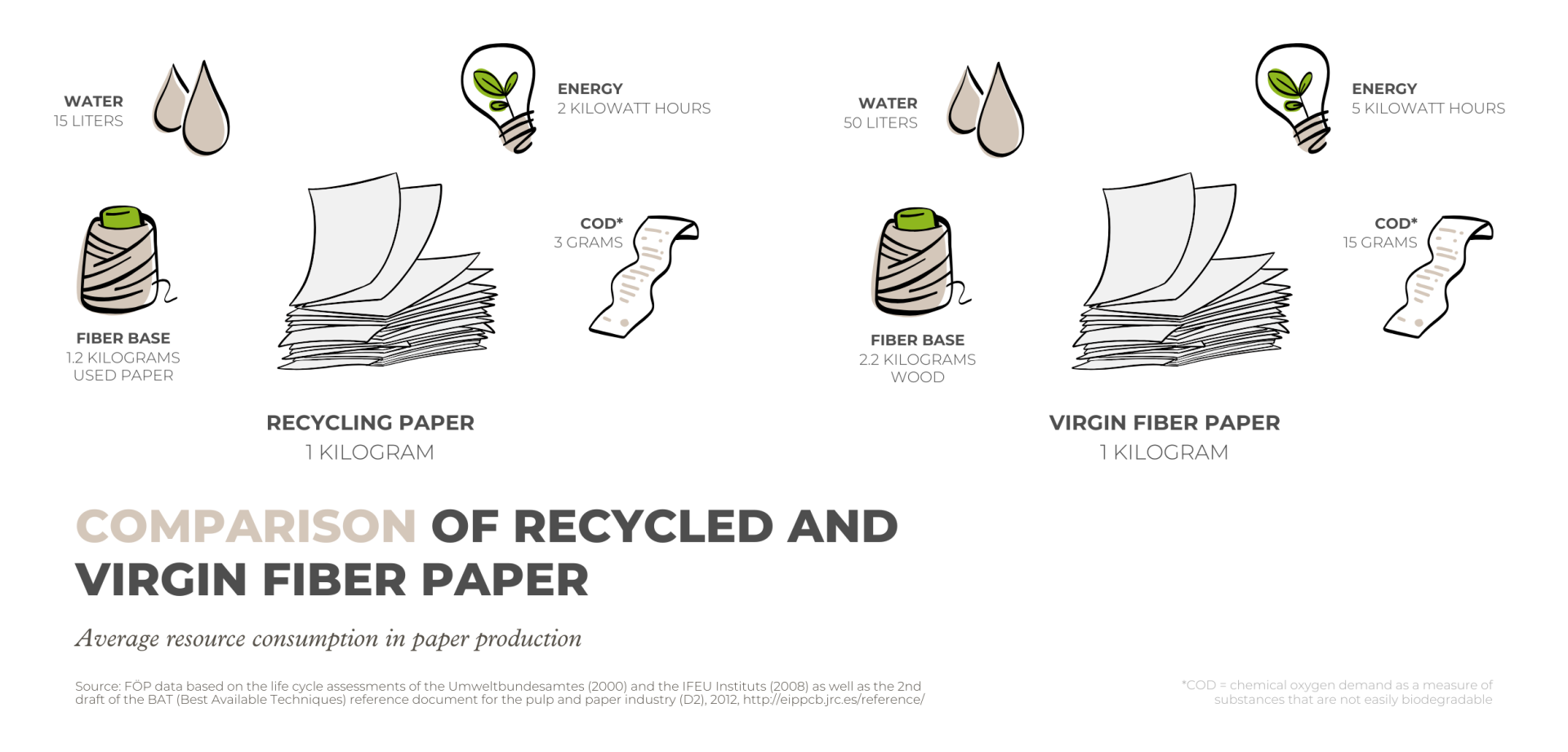
The term natural paper itself does not necessarily indicate a more sustainable type of paper but often refers to a natural look and feel, regardless of whether it is made from recycled or virgin fibers. Natural papers can be recycled or made from alternative raw materials such as grass, hemp, or limestone. FSC® or PEFC® certified papers are also often referred to as natural papers because they are sourced from sustainably managed forests. However, they can also be virgin fiber papers, which have a significantly worse environmental record than recycled papers.
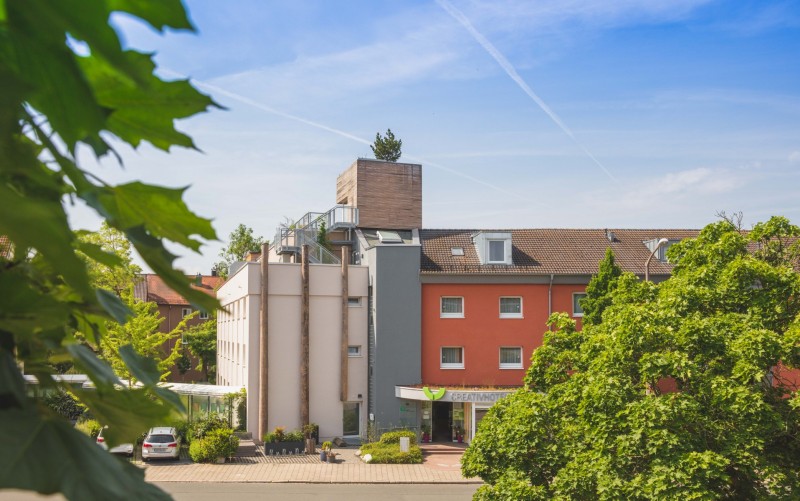
Almost all hoteliers in the Green Pearls® network choose recycled or alternative paper types when printing cannot be avoided or replaced by other measures. The Hotel Luise in Erlangen, Germany, uses recycled paper or paper made from sugar production waste for the few printed items, such as the hotel calendar or brochure. The APIPURA hotel rinner in South Tyrol is increasingly using apple paper made from apple juice production waste. Other popular alternatives include paper made from grass or hemp, or newer varieties made from cup plant, sugar beet, or bamboo.

Challenge 2: Colors
Whether in a print shop or hotel: Printing anything requires ink. Conventional inks often use mineral oils as binders and contain plasticizers and heavy metals. Not good for the environment or your health. Fortunately, with the growing demand for environmentally friendly production, more and more inks are non-toxic, some even food safe, biodegradable or compostable, and contain no hazardous ingredients. For example, mineral oils are being replaced by vegetable oils such as linseed or soybean oil. Another important aspect of the environmental friendliness and sustainability of inks is good deinkability, which allows them to be easily and completely removed from the paper during recycling.
You can also look for mineral oil-free and non-toxic inks in hotels. The LA VIMEA Vegan Hotel in Naturno, South Tyrol, is a prime example of a well-thought-out in-hotel printing solution. Instead of traditional ink cartridges, which create additional waste, the hotel uses a printer that the team can refill from ink bottles. Although printing with this type of printer takes a little longer, the LA VIMEA team points out: “We believe we can dedicate that time to nature.” In general, however, very little is printed and almost all processes are organized via QR codes – from the menu to guest information. As a result, printed materials do not need to be reprinted when information changes.


Challenge 3: Procedure
Paper and inks ultimately determine the environmental impact of the printing process. Uncoated natural papers, for example, absorb more ink than coated varieties. To avoid unnecessary misprints (and the associated waste of paper), printing companies must be familiar with printing on such papers, assess the effects of colors and images, and advise their customers accordingly. Meanwhile, more and more sustainable printing companies are optimizing their energy and water consumption, using green electricity, having efficient logistics, and offsetting unavoidable emissions at the end of production.
Sustainability means taking responsibility for the entire life cycle of a product – from the first draft to the last page.
Laurena Hollbeck, Hotel Das Rübezahl
Print is not Dead – But it is Being Used More Consciously.
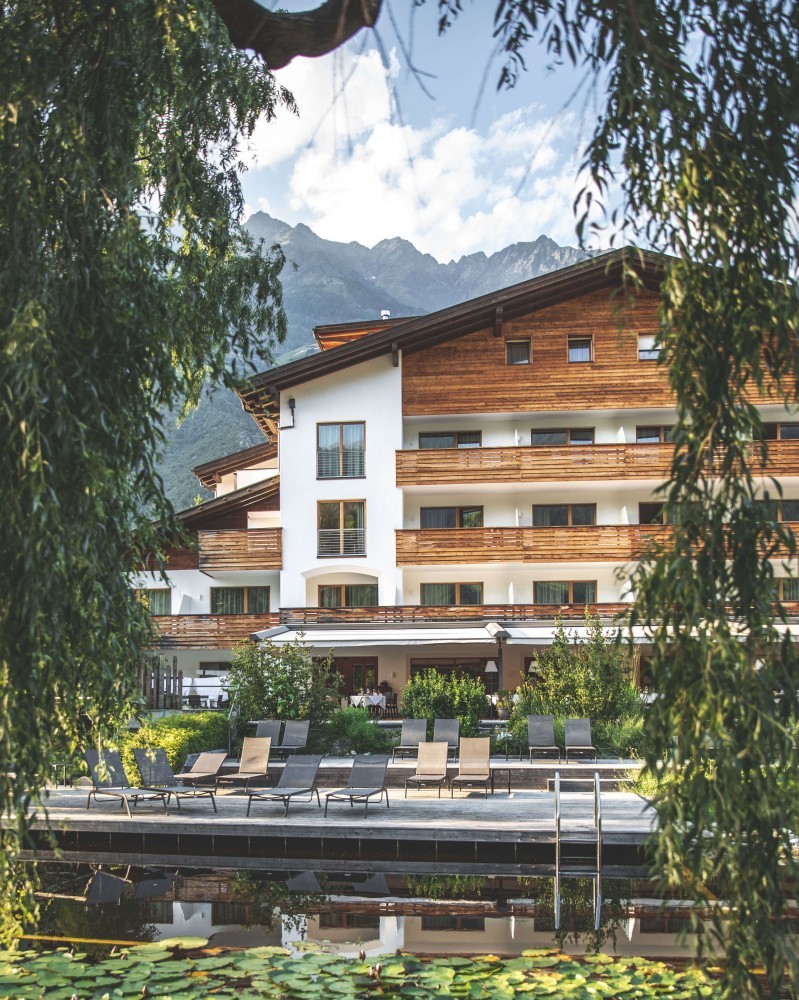
Sustainable hotels tend to do most of their communication digitally (more on this in the next part of this series, to be published on 18.06.2025). Still, for many, print has a place in their communication strategy. "We rely on digital communication and reduce printed materials, but we use sustainable paper options for important information," says Klaus Pichler of Hotel Weihrerhof in South Tyrol, summarizing his approach and that of many of his colleagues.
Conscious use is crucial: printed materials are reduced to the essentials, carefully produced and used in a targeted manner. High-quality menus, postcards, or magazines, like those of the Hotel Das Rübezahl, stay in circulation, build trust, and create a physical connection to the hotel. The conscious choice of sustainable paper, inks, and printers is not just a means to an end, but a clear part of sustainability communication. In this way, the print itself becomes a sustainable message.